


Cat Safe Indoor Flower Arrangements: A How-To Guide
Table of Contents
- Why Cat Safe Indoor Flower Arrangements Need a Plan
- Cat-Safe Flowers for Bouquets: The Reliable Shortlist
- Flowers Toxic to Cats: What Must Stay Out of the Vase
- Step by Step: Assembling a Cat-Safe Arrangement
- Flower Food, Vase Water, and Other Hidden Hazards
- How to Keep Cats Away From Flowers
- Safe Flower Placement Around Cats, Room by Room
- If Your Cat Chews a Flower: What to Do Next
- Frequently Asked Questions
Last Updated: October 20, 2026
Why Cat Safe Indoor Flower Arrangements Need a Plan
Cat safe indoor flower arrangements are bouquets built entirely from plants that are non-toxic to cats, with no harmful greenery, additives, or physical hazards. At Felted Flowers, a bouquet is only as safe as its least safe stem. One lily can undo a whole vase of roses.
Cats chew plants. It is normal grooming behavior, not mischief. And the list of flowers toxic to cats includes some of the most common stems in any florist's cooler. So planning matters more than luck.
Cat-Safe Flowers for Bouquets: The Reliable Shortlist
The reliable cat-safe flowers for bouquets are roses, gerbera daisies, sunflowers, orchids, and statice. Each appears on the American Society for the Prevention of Cruelty to Animals (ASPCA) list of plants non-toxic to cats. That list is the standard most florists and pet owners check first, and it is worth bookmarking: ASPCA Toxic and Non-Toxic Plants database.
A shortlist keeps shopping simple. Pick from it, and you avoid most risk before you ever reach the counter.
Roses, Gerbera Daisies, and Other Crowd-Pleasers
Roses are the safest crowd-pleaser in the cooler. The blooms are non-toxic to cats, and the thorns are the only real concern. Strip every thorn below the waterline and you remove the sharp edge of the risk.
Gerbera daisies bring color without toxicity. Sunflowers add height and cheer, and orchids give an arrangement a quiet, elegant focal point. Statice holds its shape for weeks and stays safe throughout.
Safe Greenery and Filler Flowers for Body and Balance
Greenery is where most cat-safe bouquets quietly fail. Filler and foliage matter as much as the blooms, and several common choices are toxic.
Safe options include:
- Areca palm fronds for soft, arching structure
- Kentia palm leaves for a fan-like backdrop
- Boston fern and bird's nest fern for airy texture
- Spider plant runners as a trailing accent
- Calathea and maranta leaves for bold pattern
Avoid eucalyptus, baby's breath, and most fern varieties sold as generic "greenery." Name matters here. Ask for the botanical name, not the trade name.
Flowers Toxic to Cats: What Must Stay Out of the Vase
Lilies are the single most dangerous flower for cats and must never enter a home with one. Every part of a lily, petals, leaves, stamens, and pollen, is toxic, and even minor exposure can cause serious harm. The Pet Poison Helpline guidance on lily poisoning is blunt about it: there is no safe amount. In Canada, veterinarians commonly cite true lilies (Lilium species) and daylilies (Hemerocallis) as the highest-risk bouquet stems because a cat can be exposed simply by grooming pollen off its fur.
Other flowers that must stay out of the vase, with the reason each is risky:
- Peace lily (not a true lily, but still toxic), contains calcium oxalate crystals that irritate the mouth and throat; causes drooling and pawing at the mouth.
- Tulips and hyacinths, the bulb is the most toxic part, but stems and leaves also contain irritant compounds; ingestion can cause vomiting and drooling.
- Daffodils, contain lycorine, which triggers vomiting, diarrhea, and abdominal pain; the bulb is especially dangerous.
- Chrysanthemums, contain pyrethrins and other irritants that can cause drooling, vomiting, and skin irritation.
- Baby's breath, often dismissed as harmless filler, but it contains saponins that can cause gastrointestinal upset.
- Eucalyptus, contains essential oils that are toxic to cats; even chewing a stem can cause drooling and vomiting.
- Alstroemeria, contains tulipalin A, which can cause mouth irritation and gastrointestinal signs.
Plant identification by botanical name is your best defense. Common names vary by region and by seller, so confirm the Latin name before you buy. A stem sold as "lily" may be a true lily, a peace lily, or a daylily, and all three carry different risks. When in doubt, ask the seller for the botanical name and cross-check it against a recognized toxicity reference before the flowers come home.
Step by Step: Assembling a Cat-Safe Arrangement
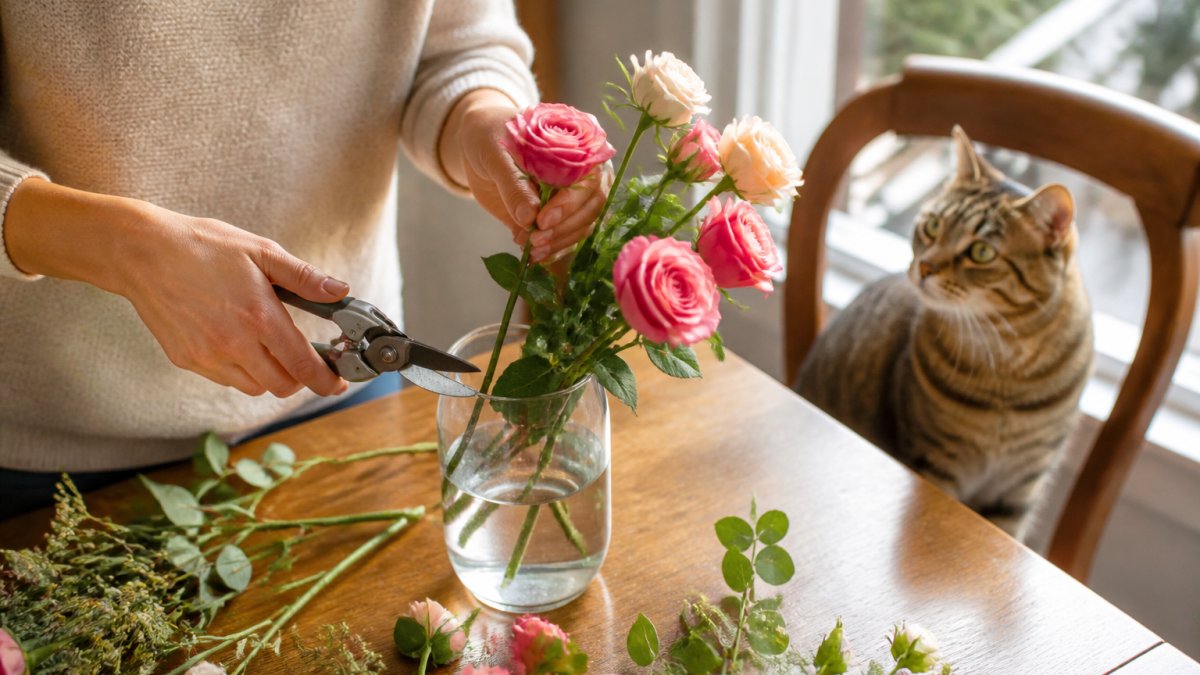
Here is the process to build a cat-safe bouquet from scratch. It takes about fifteen minutes and needs no special tools beyond sharp snips.
- Choose a heavy, stable vase. A wide base resists tipping when a cat investigates.
- Strip all foliage below the waterline. Leaves left underwater rot and cloud the water.
- Remove every thorn from roses with snips or a thorn stripper.
- Build the greenery frame first. Place palm or fern stems at an angle to create structure.
- Add focal blooms. Roses, gerberas, or orchids go in next, tallest at the back.
- Fill gaps with statice for texture and color.
- Set the vase where a cat cannot reach it. More on that below.
Expected result: a balanced bouquet with no toxic stems, no thorns, and no loose bits a cat could bat onto the floor.
Flower Food, Vase Water, and Other Hidden Hazards
The hidden hazards in a bouquet are rarely the flowers themselves. Commercial flower food, vase water, and pesticide residue on stems can cause trouble.
Bathroom or Side Table Mini Vase with Butterfly Ranunculus →
Flower food packets contain sugar, acid, and sometimes dye. A cat that laps vase water swallows all three. Skip the packet entirely for cat households, or keep it well out of reach.
Pesticides are another quiet risk. Many imported stems are treated before sale. For a lasting, zero-risk option, felt flowers sidestep the issue completely. Our Mini Side Table Bouquet in Old Fashioned Roses uses Merino wool and recycled polyester felt, with no water, no food, and nothing a cat can drink.

How to Keep Cats Away From Flowers
Keeping cats away from flowers comes down to placement and distraction, not punishment. Cats investigate what is new and reachable, so change both. The most effective approach is to treat prevention as a layered system rather than a single trick, cats solve problems, and a barrier that works for one cat may be ignored by another.
A few approaches that work, and why:
- Use double-sided tape on the shelf edge near the vase, cats dislike the sticky sensation on their paws, which interrupts the jump before it lands.
- Place a citrus peel nearby; most cats dislike the scent, though the effect fades as the peel dries, so refresh it every day or two.
- Offer a cat grass pot as a decoy, a safe, chewable alternative redirects the behavior rather than just blocking it.
- Skip the coffee table and use a high shelf instead, height alone is not enough if the shelf is within a cat's jump arc, so measure the gap from the nearest launch point.
- Choose a heavy, wide-based vase, a stable vase resists tipping when a cat investigates, reducing the chance of water and stems ending up on the floor.
Never rely on a single barrier. Cats solve problems. Layer two or three deterrents and rotate them, because cats habituate to the same cue over time. A common pattern is to combine a physical barrier (tape or a shelf riser), a scent deterrent (citrus peel), and a redirect (cat grass) so that defeating one layer does not give access to the flowers.
Safe Flower Placement Around Cats, Room by Room
Safe flower placement around cats means matching each room to how much access your cat has. A bedroom cat and a hallway cat need different plans.
| Room | Risk Level | Best Placement | Why |
|---|---|---|---|
| Living room | High | High shelf or mantel | Counter surfing and tail swipes |
| Bedroom | Medium | Bedside table, pushed back | Close supervision at night |
| Bathroom | Low | Wall shelf or windowsill | Short visits, less curiosity |
| Kitchen | High | Out of reach or skip | Food and water draw cats in |
| Entryway | Low | Console table, back edge | Passing traffic only |
Counter surfing is the main threat in kitchens and living rooms. A vase within a cat's jump arc will get tested. Our Bathroom or Side Table Mini Vase with Butterfly Ranunculus suits low-traffic spots like a bathroom shelf, where a cat rarely lingers.

If Your Cat Chews a Flower: What to Do Next
If your cat chews a flower, remove the plant from reach and note exactly which one it was. Then watch for drooling, vomiting, or lethargy, and call your veterinarian or an animal poison service if any appear.
Steps to follow:
- Identify the plant by botanical name if you can
- Remove all plant material from the cat's reach
- Rinse the mouth with water if the cat allows it
- Watch for symptoms for the next few hours
- Call your vet with the plant name in hand
Do not wait for symptoms with lilies. Call immediately.
Frequently Asked Questions
Which flowers are safe for cats in a bouquet?
Roses, gerbera daisies, sunflowers, orchids, and statice are commonly cited as cat safe flowers for bouquets. Pair them with safe greenery such as areca palm fronds or Boston fern rather than lilies or eucalyptus. Always confirm the botanical name, since common names vary between shops and regions. If you want zero risk from ingestion, a felt bouquet sidesteps the question entirely: the mini vase with butterfly ranunculus is $28 and has nothing a cat can absorb.
How can I keep my cat away from indoor flower arrangements?
Place arrangements on high shelves, in closed cabinets, or in rooms your cat does not access. Cats jump, so height alone is not enough; combine it with a stable, tip-resistant vase and a surface with no launch pad nearby. Citrus scent, double-sided tape on the shelf edge, and offering a cat grass alternative can redirect attention. Never rely on a single deterrent. If your cat is persistent, a felted bouquet removes the incentive to investigate.
What should I do if my cat chews a flower?
Remove the plant from reach, rinse your cat's mouth with water, and note the exact flower name. Watch for drooling, vomiting, lethargy, or appetite changes. For known toxic plants such as lilies, contact your veterinarian or an animal poison service immediately rather than waiting for symptoms. Bring a piece of the plant or a photo with you. Prompt action matters most with lilies, which can cause severe kidney damage in cats.
Are dried flowers safe to display around cats?
Dried flowers carry the same toxicity as the fresh plant, so a dried lily is still a dried lily. They also shed small pieces that cats bat and swallow, and some dried arrangements are treated with dyes or preservatives. If you want the look of dried stems without the risk, handcrafted felt flowers give you lasting texture and color with no plant material to chew. The bedside table bouquet in a green vase is $38 and holds its shape indefinitely.
A cat-safe bouquet takes a little planning, but the payoff is a home where flowers and pets coexist without worry. If you would rather remove the risk entirely, Felted Flowers makes handcrafted bouquets from Merino wool and recycled polyester felt blends, designed flower by flower on Saltspring Island. They hold their shape for years, never need water, and give a curious cat nothing to chew. Get started with Felted Flowers and enjoy lasting floral decor that pets can live beside.
Leave a comment