


Are Felt Flowers Safe for Cats? A 2026 Safety Guide
Table of Contents
- Are Felt Flowers Safe for Cats? The Short Answer
- Are Artificial Flowers Safe for Cats? Fresh vs. Felt vs. Silk
- Toxic Plants, Petals, and Pollen: What Real Flowers Do to Cats
- The Real Risks: Chewing, Swallowing, and Blockage
- Materials and Dyes: What Goes Into a Safe Felt Flower
- What to Do If a Cat Eats Felt
- How to Keep Cats Away From Flowers in Your Home
- Conclusion: Felt Flowers as a Cat-Safe Home Decoration
- Frequently Asked Questions
Last Updated: October 7, 2026
Are Felt Flowers Safe for Cats? The Short Answer
Yes, are felt flowers safe for cats? They generally are.
This guide from Felted Flowers answers the question directly, then covers the risks that actually matter: chewing, swallowing, dyes, and placement.
The real danger with any flower, real or fake, is not the material itself. It is what your cat does with it.
So here is the honest version most guides skip: felt flowers are not poisonous, but they are still a physical object a cat can chew, shred, and swallow.
Are Artificial Flowers Safe for Cats? Fresh vs. Felt vs. Silk
Artificial flowers are usually safer for cats than fresh ones, because they skip the toxic plant problem entirely.
Here is how the three main types compare:
| Type | Toxic to Cats? | Main Risk | Best For |
|---|---|---|---|
| Fresh flowers | Often yes | Poisoning from lilies, tulips, and more | Homes without cats |
| Felt flowers | No | Chewing and swallowing fibers | Cat households |
| Silk flowers | No | Dyes, wire stems, and shedding | Low-contact display |
Fresh flowers win on scent and realism. They lose badly on safety.
Felt flowers flip that trade-off. They are soft, they last for years, and they carry no plant toxins.
If you want the look of fresh blooms without the risk, felt is the safer pick for a home with cats.
Toxic Plants, Petals, and Pollen: What Real Flowers Do to Cats
The plants to know about:
- Lilies are the most dangerous. Even a small amount, including pollen and vase water, can cause kidney failure in cats (Lilies Ingestion - No Lilies for Kitties).
- Tulips contain toxins in the bulb that can trigger vomiting and drooling.
- Mistletoe is a holiday hazard that can cause vomiting, lethargy, and worse if eaten.
What most people miss is that the whole plant matters, not just the flower head. Petals, leaves, stems, stamen, and pollen can all carry toxins.
This is the core reason felt flowers exist as a pet-safe alternative. There is no pollen to groom off, no vase water to drink, and no bulb to dig up. The plant chemistry simply is not there.
If you suspect your cat has eaten any real plant, contact your veterinarian or a pet poison helpline right away.
The Real Risks: Chewing, Swallowing, and Blockage
Felt flowers are not toxic, but they are still objects, and objects get chewed. The real risk with felt is physical, not chemical.
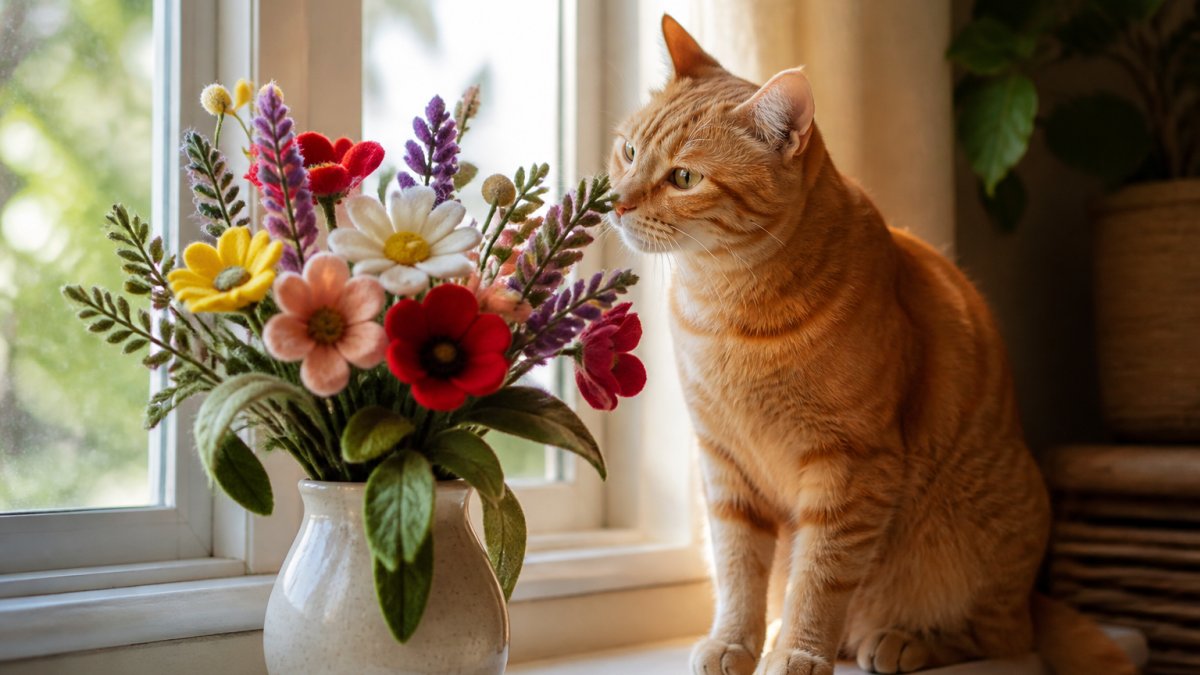
Here is what can actually happen:
- Ingestion. A cat that swallows felt fibers may pass them without issue, or may not.
- Choking. A large piece, or a felt flower pulled off its stem, can lodge in the throat.
- Intestinal blockage. Swallowed felt cannot be digested. In serious cases, a clump of fibers can block the gut and require surgery.
The thing nobody tells you about felt is that it shreds rather than snaps. A bored cat can pull a flower apart into small pieces fast, and those pieces are easy to swallow.
Materials and Dyes: What Goes Into a Safe Felt Flower
Safe felt flowers start with safe materials, but "felt" is not one thing. It is a family of pressed fabrics, and the way a flower is made decides whether it belongs in a cat-safe home. Most guides stop at "wool versus synthetic." The useful version goes one layer deeper.
The two base fibers
- Wool felt. Made from natural wool fibers that mat together through heat, moisture, and agitation. Wool fibers have microscopic scales that lock onto each other, which is why good wool felt is dense and holds its shape. Dense felt shreds into fewer, larger pieces instead of dissolving into fluff.
- Synthetic felt. Made from synthetic fibers such as polyester, often bonded with heat or a needle-punch process. It is cheaper and comes in brighter colors, but lower grades pill and shed more, and shedding is exactly what you do not want around a cat that grooms.
A practical middle ground is a wool-and-recycled-polyester blend: the wool gives density and structure, the polyester adds durability and colorfastness.
Dyes, adhesives, and finishes
Color and construction matter as much as fiber. A few specifics:
- Dyes. Low-cost felt sometimes uses poorly fixed dye, so color can flake or transfer onto a damp paw or a cat's fur. Better makers use azo-free dye and fix it properly so the color stays locked in the fiber.
- Adhesives. Glue is the hidden ingredient in many felt flowers. Hot glue and craft adhesives can soften in a warm room, and a cat that chews a glued petal can swallow a tacky lump. Look for stitched construction over glued construction where possible.
- Coatings and stiffeners. Some petals are stiffened with starch, wax, or a spray finish. These are usually low-risk, but a strong chemical odor is a signal the finish has not cured.
- Scented treatments. Fragrance oils and scented sprays are the one additive that can genuinely irritate a cat. Cats are far more sensitive to many essential oils and fragrance compounds than people are, so unscented felt is the safer default.
A five-minute buyer's check
Before you bring a felt flower home, run this:
- Smell it. A sharp chemical or perfume odor is a red flag. Unscented is best.
- Rub it with a damp white cloth. Any color transfer means the dye is not fixed.
- Pull gently at the fibers. Shedding means loose pieces your cat can swallow.
- Look for glue strings and loose embellishments. Beads, buttons, and tiny leaves are choking hazards, not just decoration.
- Check for wire. Wire stems and armatures can poke through felt and injure a cat's mouth or gut if swallowed.
If a maker will not tell you the fiber content or the dye type, treat that as your answer and keep looking.
What to Do If a Cat Eats Felt
If your cat eats felt, stay calm and watch for symptoms. Most small amounts pass through, but you need to know the warning signs.
Symptoms to watch for after exposure:
- Vomiting, especially repeated
- Lethargy or hiding
- Loss of appetite
- Drooling or pawing at the mouth
- Straining to poop, or no poop at all
If you see any of these, call your vet. Bring the felt flower with you so they can see the material and size.
For a single small fiber, most cats are fine. For a chunk of felt, or a flower pulled off its stem, treat it as urgent. Ingestion of a large piece is the scenario that leads to intestinal blockage.
How to Keep Cats Away From Flowers in Your Home
Keeping cats away from flowers comes down to placement, distraction, and supervision. You do not need to lock your decor in a cabinet. You need to make the flowers boring and the alternatives more fun. But placement is only half the job, the other half is building or choosing arrangements that survive a curious cat.
Display rules that actually work
- Place high and back. Put arrangements on shelves, mantels, or wall ledges a cat cannot reach, and set them back from the edge so a swipe cannot hook them.
- Use a heavy, wide-base vase. A weighted base stops a cat from tipping the whole thing over, and a wide base is harder to paw off a shelf.
- Anchor the arrangement. Museum putty or a non-slip mat under the vase keeps it in place during a playful swat.
- Skip loose strands. Trim any dangling ribbon, twine, or felt scraps, anything that dangles is a toy to a cat.
- Offer a decoy. A catnip toy or a pet toy near the display redirects attention away from the flowers.
- Supervise new cats. A new cat will test everything once. Watch closely for the first week and adjust placement as you learn its habits.
How to make cat-safer felt flowers
If you craft your own, a few construction choices cut the physical risk sharply:
- Skip wire stems. Use rolled felt, wooden dowels, or stiffened fabric instead of wire that can poke through and be swallowed.
- Stitch, don't glue. Sewn petals stay attached; glued petals pop off under chewing.
- Avoid small parts. No beads, buttons, sequins, or tiny leaves a cat can bite off and swallow.
- Reinforce the base. Wrap and stitch the stem-to-flower joint so a determined cat cannot pull the bloom free.
- Choose disclosed materials. Use unscented, well-fixed felt from a maker who lists fiber content and dye type.
- Test the pull. Give each flower a firm tug before display. If anything shifts, reinforce it.
Holiday and seasonal displays
For holiday decoration, this matters even more. Cats are curious about new objects, and a festive arrangement is a magnet. Place felt home decoration out of reach during the busy season, check it daily for loose parts, and keep tinsel, ribbon, and string lights, the classic holiday hazards, well away from the display.
Conclusion: Felt Flowers as a Cat-Safe Home Decoration
Felt flowers give you the beauty of a flower arrangement without the plant toxins that make fresh blooms risky for cats. The material is safe.
At Felted Flowers, we handcraft every bloom from high-quality Merino wool and recycled polyester felt blends, designed one flower at a time on Saltspring Island.
Want floral art that fits a cat-safe home? Browse our gallery and find a piece made for your space. Shop Gallery Art and bring home decor that stays beautiful and safe.
Frequently Asked Questions
Are felt flowers safe for cats?
Felt flowers are generally safer for cats than fresh or silk flowers because they contain no toxic plant compounds like those found in lilies or tulips. The main risk is physical, not chemical: a cat that chews and swallows felt pieces could experience choking or intestinal blockage. Choose felt flowers made from wool or recycled polyester with azo-free dyes, and keep small or loose parts out of reach.
Can cats chew or swallow felt?
Yes. Cats are drawn to felt's soft texture, and some will chew or bite at it. Small swallowed pieces usually pass through, but larger clumps or felt wrapped around wire stems can cause choking or a blockage that requires veterinary care. Signs to watch for include vomiting, lethargy, and loss of appetite. If you see these after your cat has chewed a felt flower, contact your veterinarian.
Are wool felt flowers safer for cats than artificial flowers?
Wool felt is often a better choice than silk or plastic artificial flowers because it contains no toxic dyes or synthetic finishes that cats might ingest. Silk flowers can shed small fibers, and plastic stems may splinter. The physical risk of chewing still applies, so supervise your cat around any arrangement.
How do I keep my cat away from a felt flower arrangement?
Place felt flower arrangements on high shelves, inside closed cabinets, or in rooms your cat cannot access. Providing your cat with its own felt toys can redirect chewing behavior away from your decor.
Felt flowers solve the toxicity problem, but they still need smart placement around curious cats. Felted Flowers handcrafts each bloom from Merino wool and recycled polyester felt blends, so your arrangement holds its shape and color for years without shedding loose pieces. Every bouquet is designed flower by flower, with custom options for colors and flower types. Get started with Felted Flowers and decorate your home with floral art built to last.
Leave a comment