


How to Display Felt Flowers: 7 Styling Methods That Work
Table of Contents
- Quick Start: What You'll Need to Display Felt Flowers
- 7 Ways to Display Felt Flowers in Your Home
- Best Vases for Felt Flowers: Sizing and Style Guide
- Felt Flower Arrangement Ideas for Every Room and Season
- How to Clean Felt Flowers Without Damaging Them
- Structural Mounting: How to Hang and Secure Felt Flowers
- Common Mistakes to Avoid When Displaying Felt Flowers
- Frequently Asked Questions
Last Updated: September 20, 2026
Quick Start: What You'll Need to Display Felt Flowers
Learning how to display felt flowers starts with a few basic supplies. This guide from Felted Flowers walks through seven styling methods, plus the mounting and cleaning details most guides skip.
- A hot glue gun and clear adhesive
- Floral wire stems and floral tape
- Small nails, adhesive hooks, or a picture rail
- Sharp scissors for trimming stems
- A soft brush or lint roller for dusting
7 Ways to Display Felt Flowers in Your Home
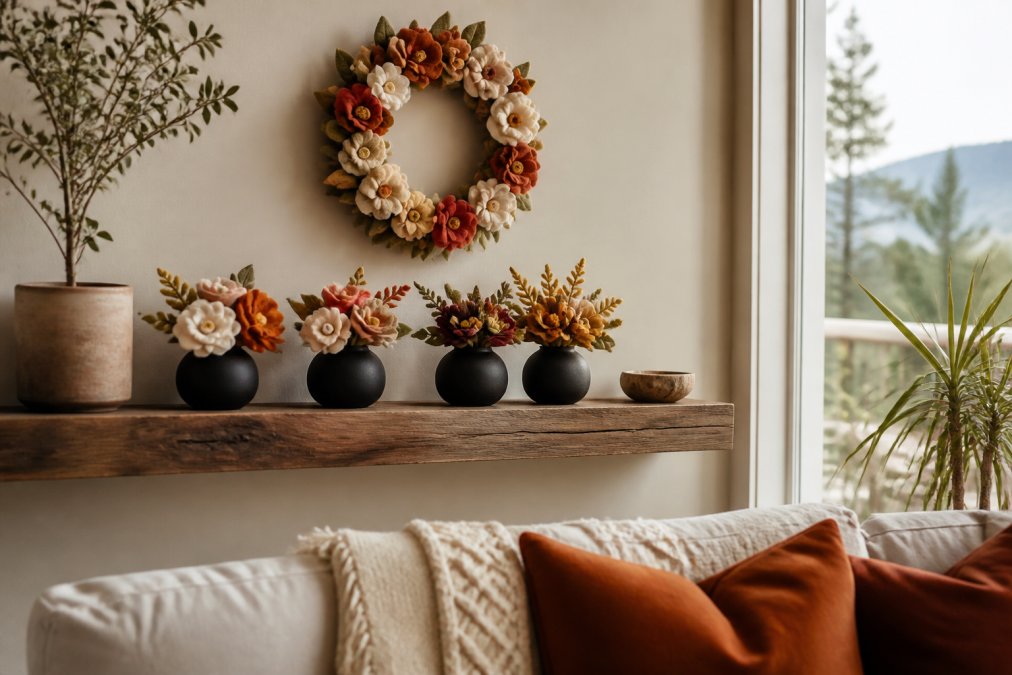
Tabletop Arrangements and Centerpieces
A tabletop bouquet is the easiest place to start. Set one on a dining table, console, or nightstand and you get color without watering or wilting. The Table Bouquet in Black Vase stands approximately 20 cm high by 10 cm wide, which fits a narrow console without crowding it.

Wall Art, Wreaths, and Curtain Tie Backs
Wall art turns felt flowers into a year-round feature. A wreath works on a front door or above a mantel, and it survives rain far better than dried flowers. Curtain tie backs are the sleeper hit: a short garland of blooms gathered at each side of a window adds softness without blocking light.
Personal Touches: Picture Frames, Clothing, and Accessories
Small blooms glued to a picture frame corner make a plain frame feel custom. On clothing, stitch or glue a single flower to a jacket lapel, a hat band, or a tote bag. Use strong adhesive for anything that gets handled often.
Best Vases for Felt Flowers: Sizing and Style Guide
The best vase for felt flowers is one that matches the bouquet's scale and holds it steady. Felt stems do not drink water, so the vase is purely structural and decorative.
| Bouquet Size | Vase Height | Best Placement |
|---|---|---|
| Compact, under 20 cm | 10-15 cm | Shelf or nightstand |
| Medium, 20-28 cm | 15-20 cm | Console or dining table |
| Tall, over 28 cm | 20-25 cm | Floor or entryway |
Felt Flower Arrangement Ideas for Every Room and Season
Most guides stop at "reds for fall, pastels for spring." That is a starting point, not a styling system. Felt flowers are dimensional textile art, so the arrangement has to work on two levels at once: the color story and the physical texture of the blooms. Get both right and a handmade bouquet reads as intentional decor rather than a craft project.
Build a Color Story Before You Build the Bouquet
The 60-30-10 rule is the fastest way to keep a felt arrangement from looking busy: 60 percent dominant color, 30 percent supporting color, 10 percent accent. But felt adds a variable fresh flowers do not have, surface texture. A palette that looks balanced on paper can still feel flat if every bloom is the same felt weight and finish.
- Living room, fall: terracotta and rust as the dominant pair, mustard as the 10 percent accent, one cream bloom to break the warmth
- Bedroom, spring: blush and sage as the dominant pair, a single deeper rose as the accent, all blooms in soft matte felt
- Kitchen, summer: white and butter yellow dominant, a single tomato-red bloom as the accent, kept to a low bud vase so it does not compete with counter clutter
- Entryway, winter: deep evergreen and charcoal dominant, a warm cream accent, taller stems so the arrangement reads from the doorway
- Home office, year-round: muted blue and oatmeal dominant, one burnt orange accent, low saturation so it does not pull focus on video calls
Match Texture to the Room's Light
Felt absorbs light rather than reflecting it, so a bouquet that looks rich in a bright room can look muddy in a dim hallway. In low-light spaces, lean toward lighter values and higher-contrast accents. In bright, sun-filled rooms, deeper saturated colors hold their own without washing out.
Scale and Placement by Room
- Hallway or entryway: one tall, narrow arrangement, a single focal point beats a cluster in a pass-through space
- Dining table: a low, wide grouping that sits below eye level so guests can see across the table
- Bedroom nightstand: one compact bouquet, no taller than the lamp base, so it does not crowd the surface
- Kitchen windowsill: a single-stem bud vase; reserve multi-stem arrangements for open counter space
- Home office: a small arrangement placed to the side of the monitor, never directly behind it
Rotate Seasonally Without Rebuying
Because felt flowers do not wilt, you can build a small core set of neutral blooms, cream, oatmeal, soft green, and swap only the accent stems each season. One terracotta stem in fall, one blush stem in spring, one evergreen stem in winter. That keeps the display fresh without a full replacement each quarter.
How to Clean Felt Flowers Without Damaging Them
To clean felt flowers, dust them gently with a soft brush or a lint roller on low tack. Never soak felt in water, and never put it in a washing machine.
- Brush the petals with a soft-bristled brush.
- Use a lint roller for loose fibers.
- Spot-clean stains with a barely damp cloth and mild soap.
- Air-dry away from direct heat.
Structural Mounting: How to Hang and Secure Felt Flowers
Hanging felt flowers safely comes down to three variables: the weight of the piece, the surface you are mounting to, and the anchor type that surface will accept. Most guides cover weight and stop there. The surface is where displays actually fail, a hook that holds on drywall will slide off glass, and an adhesive that grips painted wood can pull the finish when removed.
Step 1: Weigh the Piece Accurately
Use a kitchen scale, not an estimate. A dense felt bouquet in a ceramic vase can weigh two to three times what it looks like, because felt traps air and the vase adds dead weight. Weigh the finished arrangement, vase included, before you choose any hardware.
Step 2: Match the Anchor to the Surface
| Surface | Best Anchor | Avoid |
|---|---|---|
| Painted drywall | Small nail into a stud, or a screw-in drywall anchor rated above the piece's weight | Standard adhesive strips on textured paint |
| Glass or mirror | Suction cup rated above the weight, or a removable clear adhesive hook designed for glass | Nails, screws, or standard adhesive strips |
| Solid wood or trim | Small finishing nail or a screw-in cup hook | Heavy adhesive that can lift the finish on removal |
| Brick or stone | Masonry bit and plastic anchor | Adhesive of any kind |
| Fabric (curtains, upholstery) | Stitch a fabric loop and hang from the existing rod or a hidden pin | Glue directly to the fabric |
Step 3: Mount Without Damaging the Base
The safest rule for felt displays is: never glue felt directly to a surface you care about. Instead, attach the felt to a backing, a small wooden plaque, a hoop, or a fabric-wrapped board, and mount the backing. That way the felt is removable and the wall, glass, or furniture underneath is untouched.
Step 4: Test Before You Commit
Hang the piece, then press gently downward and sideways. If the anchor shifts, stop and go up one weight rating. A display that holds for an hour can still fail overnight if the anchor is borderline.
Step 5: Plan for Removal
If you rent, or if you rotate displays seasonally, choose removable anchors and keep the original packaging so you can match the removal instructions. A felt display you can take down cleanly is one you will actually change with the seasons.
Common Mistakes to Avoid When Displaying Felt Flowers
The biggest mistake is treating felt flowers like fresh stems. They do not need water, and they should not sit in direct sun or damp rooms.
Other common errors:
- Cropping a tall bouquet in a short vase
- Using weak adhesive on wearable pieces
- Hanging heavy arrangements on lightweight hooks
- Storing felt in plastic, which traps moisture
- Skipping dusting until colors dull
Frequently Asked Questions
What can I do with felt flowers?
Felt flowers work in more places than fresh blooms. Set them in a vase as a centerpiece, mount them on a wall as dimensional art, weave them into wreaths and door decor, or attach them to picture frames, curtain tie backs, and accessories. Because they hold their shape, you can also use them in shadow boxes and photo displays where real flowers would wilt. Start with one arrangement in a high-traffic spot, then add pieces as you find spaces that need color.
How do you keep felt flowers dust-free while on display?
Dust settles on wool felt the same way it does on any textile, but cleaning is simple. Use a soft brush and pass it over the petals every few weeks. For deeper cleaning, a lint roller works well on flat surfaces. Keep arrangements away from open windows and kitchen grease, which attract more dust. If a piece looks dull, a gentle pass with a barely damp cloth restores the nap without soaking the fibers.
What are the best containers for displaying felt flowers?
The container should match the scale of the arrangement, not compete with it. A compact bouquet looks best in a small vase, while a taller arrangement needs a vase with enough weight to stay upright. The Table Bouquet in Black Vase at $79.00 stands approximately 20 cm high by 10 cm wide and suits a dining table or console. For smaller shelves, the Mixed Bouquet in small black vase at $69.00 keeps the footprint tight. Neutral tones let the flower colors lead.
Can felt flowers be used in wall-mounted arrangements?
Yes, and wall mounting is one of the most striking ways to show them. Use wire stems or floral tape to build the shape first, then secure the piece to a lightweight backing board or hoop with hot glue. Command strips or small nails hold most arrangements, but check the weight before hanging. Keep wall pieces out of direct sunlight, since prolonged UV exposure can fade dyed wool over time. A hallway, bedroom, or covered porch wall works well.
Felt flowers last for years, but only if you display and store them with care. Felted Flowers handcrafts every bloom from Merino wool and recycled polyester felt blends, designed on Saltspring Island and built to keep its shape season after season. Each piece is a one-of-a-kind work of art, with custom bouquet design available when you want exact colors and flower types. Get started with Felted Flowers and bring long-lasting floral decor into every room.
Leave a comment