


Handmade Floral Art for Home: Your 2026 Guide
Table of Contents
- Why Handmade Floral Art Belongs in Every Room
- Floral Home Decor Ideas for Living Rooms, Bedrooms, and Hallways
- Handmade Floral Wall Art: Making a Blank Wall Bloom
- Felt Flower Wall Decor That Suits Modern and Vintage Rooms
- Custom Felt Flower Bouquets for Weddings and Gifts
- What Handmade Floral Art Really Costs
- Caring for Felt Floral Decor So It Lasts for Years
- Common Mistakes When Buying Handmade Floral Art
- Frequently Asked Questions
Last Updated: October 12, 2026
Why Handmade Floral Art Belongs in Every Room
Handmade floral art for home is fiber artwork in which every petal, leaf, and stem is cut and shaped by hand from materials such as Merino wool felt, then arranged into a lasting bouquet or wall piece. At Felted Flowers, our Salt Spring Island studio is built on exactly this idea: flowers that stay.

The appeal goes beyond longevity. Fresh bouquets are a recurring cost and a weekly chore; a handcrafted piece is a one-time purchase that becomes part of the room.
The harder question is how to choose well: which format suits your wall, what a fair price looks like, and how to keep the piece looking new.
Floral Home Decor Ideas for Living Rooms, Bedrooms, and Hallways
Floral home decor ideas work best when the piece matches the room's job: a living room wants a focal arrangement, a bedroom something softer at eye level, a hallway a piece that survives passing traffic.
Start with scale.
Then match the palette to the light. North-facing rooms flatten warm tones, so saturated reds and oranges hold up better there. South-facing rooms can carry softer pastels without washing out.
- Living room: one statement centerpiece on the mantel or coffee table, plus a coordinating wall piece
- Bedroom: a single arrangement on a nightstand or dresser, in muted or dusty tones
- Hallway: wall-mounted art rather than a floor piece, so nothing gets knocked over
Handmade Floral Wall Art: Making a Blank Wall Bloom
Handmade floral wall art solves the problem a paint color cannot: a large wall that feels unfinished.
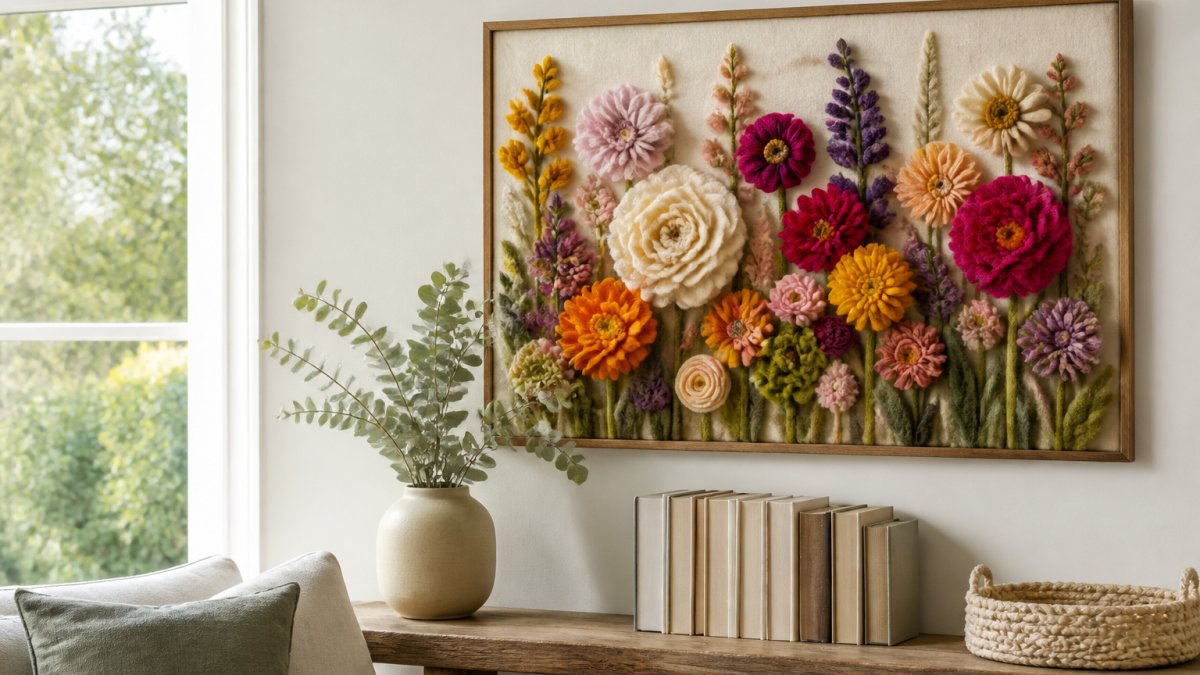
Three formats dominate, and the choice comes down to how much visual weight you want:
| Format | Best For | Typical Look |
|---|---|---|
| Single framed piece | Small walls, tight budgets | One focal bloom cluster |
| Multi-panel set | Long or double-height walls | Coordinated across panels |
| Unframed dimensional piece | Renters, frequent movers | Texture-forward, lighter look |
Framed prints suit rooms where you want the artwork contained and protected. Unframed dimensional pieces suit rooms where the texture itself is the point. Neither is better; they answer different questions.
The main handmade techniques, compared
If the intent is genuinely handmade, the technique drives difficulty, durability, and how the piece ages. Here is how the common approaches stack up.
| Technique | Skill Level | Durability | Best For | Watch Out For |
|---|---|---|---|---|
| Pressed botanicals | Beginner | Low to moderate | Flat frames, keepsakes | Fading, brittleness, moisture |
| Paper flowers | Beginner to intermediate | Low | Temporary displays, parties | Crushing, dust, humidity |
| Felt and wool flowers | Intermediate | High | Long-term wall art, gifts | Pilling if low-grade felt |
| Embroidery and stumpwork | Intermediate to advanced | High | Detailed, framed panels | Time, hoop distortion |
| Painted canvas | Beginner to advanced | High | Large statement walls | UV fading, cracking |
| Clay and ceramic blooms | Advanced | High | Sculptural, dimensional pieces | Weight, breakage in transit |
| Dimensional mixed media | Advanced | Moderate to high | Gallery-style, textural work | Adhesive failure over time |
A practical rule: the flatter and more botanical the piece, the more it behaves like a print and needs protection behind glass; the more dimensional it is, the more it behaves like a sculpture and needs dust management instead.
Making your own, start to finish
If you want to make a piece rather than buy one, the felt route is the most forgiving starting point because the material holds its shape and does not fray. Materials:
- Wool felt or a wool-blend felt in two or three anchor colors
- Sharp fabric scissors and a small pair of detail scissors
- Floral wire or stem wire in a gauge that holds a bend
A workable sequence, in order:
- Sketch the layout. Decide the finished size and where each bloom sits before you cut anything.
- Cut templates, then petals. Cut one paper petal you are happy with, then use it to cut the felt. Cut more petals than you think you need; layering is what creates depth.
- Shape the petals. Cup them between your fingers or over the back of a spoon. Felt holds a curve once worked.
- Build each bloom. Layer small petals inside larger ones, secure at the center, and add a contrasting middle.
- Attach stems. Wrap wire with floral tape, then bond the bloom to the stem.
- Arrange and mount. Place blooms on the backing, step back to check balance, then fix them down.
- Finish and hang. Add a frame or leave it dimensional, then hang at eye level.
A beginner can finish a small single-bloom piece in an afternoon; a dense multi-flower panel is a multi-evening project. Buying saves time; making saves money and gives you control over every color.
Our own Gallery Art collection leans dimensional, because the depth is what separates felt from a poster. Our Salt Spring Island floral art piece, for example, gathers nine island wildflowers, including California poppy, camas, and fawn lily, into a single arrangement.
Felt Flower Wall Decor That Suits Modern and Vintage Rooms
Felt flower wall decor is unusually flexible across decorating styles, which is why it keeps showing up in both new builds and older homes.
In a modern room, restraint wins: clean lines, a limited palette, and generous negative space.
In a vintage room, density and warmth win: layered arrangements, muted roses and peonies, and a wooden frame reinforce the period feel.
The mistake in both cases is treating the artwork as an afterthought to the furniture.
Custom Felt Flower Bouquets for Weddings and Gifts
Custom felt flower bouquets are arrangements built to a buyer's specification: chosen flower types, colors, and size.
The practical advantage for weddings is timing. Fresh bouquets have a narrow window and a firm deadline.
For gifts, customization is what makes the piece land. If the recipient's kitchen is sage and cream, say so.
A realistic customization brief includes four things:
- Palette: two or three anchor colors, plus one accent
- Flower types: named blooms, or a mood reference such as "wildflower meadow"
- Scale: where it will sit, and how tall it needs to be
If you want something very specific, ask before you assume it is possible. Our custom bouquet design service works exactly this way.
“Salt Spring Island floral art, handcrafted flower by flower” →
What Handmade Floral Art Really Costs
Handmade floral art costs more than a supermarket bouquet and less than most people assume over time. The honest comparison is total cost over several years, not price versus price.
A fresh bouquet is a repeating expense: buy one a week and the annual figure climbs quickly, with nothing left at the end. A felt arrangement is a single purchase that stays on the shelf, usually the cheaper of the two over a few years, and still there.
What drives the price of a finished piece
Four things set the price of handmade floral art:
- Flower count. Each bloom is cut, shaped, and assembled by hand. A piece with 70 blooms is not 70 times the work of one bloom, but it is many multiples.
- Size. Larger pieces need more material, more blooms, and more structural support to hang flat.
- Material grade. Merino wool felt costs more than thin craft felt and behaves differently over years. Ask what the piece is made from.
At Felted Flowers, prices are published and fixed, which is rarer than it should be in this category:
| Piece | Price |
|---|---|
| Saltspring Island Signature Flower Arrangement | $148.00 |
| Salt Spring Island floral art, handcrafted flower by flower | $148.00 |
| Custom Artful Arrangement with Black Vase | $159.00 |
| Premium Bouquet | $298.00 |
| Gallery Art Reproduction of a 1916 Floral Painting | $980.00 |
Two things drive price: the number of individually cut flowers and the size of the finished piece. The 1916 reproduction costs what it does because it contains over 70 hand-cut blooms, that is hours, not markup.

What a DIY version actually costs
If you make your own, the budget shifts from labor to materials. A rough materials budget for a small felt floral wall piece:
| Item | Typical Range | Notes |
|---|---|---|
| Wool or wool-blend felt | $8 to $25 | Enough for several blooms |
| Floral wire and tape | $6 to $15 | Buy a spool, not a pack |
| Adhesive or glue sticks | $5 to $12 | Fabric adhesive holds better than craft glue |
| Backing board, hoop, or frame | $10 to $40 | Frame cost varies most |
| Scissors and basic tools | $15 to $35 | One-time purchase, reused |
| Pattern or template | $0 to $10 | Many are free |
A first small piece often lands in the $40 to $90 range once tools are counted, and less per piece after that because tools carry over. That is cheaper than a finished custom arrangement but costs evenings and a learning curve. Neither route is wrong; they buy different things.
The cost-per-year comparison
This is the comparison most buyers never run. A fresh bouquet bought weekly is a recurring cost with nothing left at year's end; a single handmade piece is a one-time cost still on the wall in year three. Run the numbers over three years, and the handmade piece usually wins on total spend while being the only one still there.
Caring for Felt Floral Decor So It Lasts for Years
Felt floral decor needs very little care, but the little it needs matters.
Dust is the main issue.
For storage, wrap the piece in acid-free tissue and keep it flat or upright, away from damp. Basements and garages are poor choices.
If a pet chews a petal, reshape it by hand and trim any frayed edge with sharp scissors; felt does not unravel the way woven fabric does.
- Dust every few months with a soft brush
- Keep out of direct sun and away from heat sources
- Store flat, wrapped, and dry if the piece comes down
Common Mistakes When Buying Handmade Floral Art
Buying too small. The single biggest regret. Measure the wall first, then buy.
Matching the sofa instead of the room. Art should relate to the space, not duplicate the upholstery.
Assuming all felt is the same. Material quality varies widely.
Skipping the return policy. Buying from a small maker online is a reasonable concern.
Forgetting the occasion date. Custom work takes time.
Frequently Asked Questions
How do I choose handmade floral art that suits a room?
Start with the room's existing palette. Pull one or two colors from your cushions, rug, or curtains and look for handmade floral art that repeats them. Scale matters too: an arrangement suited for a side table or shelf, while a larger piece anchors a console or dining table. For wall pieces, match the artwork's width to about two-thirds of the furniture below it. Rooms with warm wood tones pair well with earthy felt colors, while white or grey spaces can handle bolder, brighter blooms.
How do you display handmade floral art at home?
Handmade floral art works in more places than a vase. Stand a felt bouquet on a mantel, entryway console, or bedside table, or group two or three smaller pieces at different heights for a layered look. Wall-mounted felt flower decor suits hallways and above sofas, especially when hung at eye level. In dining rooms, a single arrangement as a centerpiece keeps conversation sightlines clear. Rotate pieces between rooms each season so the same artwork reads differently throughout the year.
What materials are used to make handmade floral art?
Quality handmade floral art usually starts with wool felt, often Merino, because the fine fibers hold shape and color well. Some makers blend in recycled polyester felt for durability and structure. Each petal is typically hand-cut and shaped, then assembled flower by flower, which is why no two pieces look identical. Ask the maker what the blooms are mounted on, since a stable base keeps a wall piece or arrangement from sagging over time. Materials matter most for longevity, not just appearance.
How do you care for felt floral decor?
Dust felt flowers gently with a soft brush or a vacuum on its lowest setting with a brush attachment. Keep pieces out of direct sunlight for long periods, since even colorfast wool can fade over years of strong exposure. If a petal gets crushed, most wool felt springs back when you reshape it by hand. Avoid soaking felt in water; spot-clean only when necessary and let the piece air dry away from heat. With basic care, a well-made felt arrangement can stay vibrant for years.
Is handmade floral art a good alternative for people with allergies?
For anyone who reacts to pollen, felt floral art removes the main trigger because there is no live plant material. Wool felt does not release pollen or scent, so it suits bedrooms and offices where fresh bouquets can cause sneezing. One practical note: pets sometimes mistake felt blooms for toys. Place arrangements on higher shelves in homes with cats or dogs, and check pieces occasionally for loose fibers. This keeps the artwork looking its best and avoids chewed petals.
How much should I expect to spend on handmade floral art?
Pricing reflects the hours of handwork in each piece. At Felted Flowers, arrangements and bouquets start at $148 for a design suited for a side table or shelf, while a custom artful arrangement with a black vase is $159. A large premium bouquet costs $298, and a gallery reproduction with over 70 hand-cut flowers is $980. Compared with fresh flowers bought weekly, a felt piece typically pays for itself within a year.
Leave a comment