


Fresh Flowers vs Felt: True Cost Comparison
Table of Contents
- Fresh Flowers vs Felt: Quick Comparison Table
- Initial Cost Breakdown: Fresh Flowers vs Felt
- Longevity of Felt Flowers vs Fresh: The Real Difference
- Annual Cost Analysis: What You Actually Spend
- Handcrafted Felt Wedding Floral Decor: Investment Value
- Maintenance, Care, and Hidden Costs
- Which Option Wins for Your Budget and Lifestyle
- Frequently Asked Questions
Last Updated: September 23, 2026
Fresh Flowers vs Felt: Quick Comparison Table
When you're deciding between fresh flowers and felt alternatives for weddings, home decor, or gifts, the choice comes down to more than just upfront cost. A single fresh bouquet costs between $50-$150 from most florists, but that's only the beginning of what you'll actually spend. Felt flowers, by contrast, represent a one-time investment that lasts indefinitely. Felt flowers, by contrast, represent a one-time investment that lasts indefinitely. Here's how they stack up:

| Factor | Fresh Flowers | Felt Flowers |
|---|---|---|
| Initial Cost | $50-$150 per bouquet | $59-$159 per bouquet |
| Lifespan | 5-14 days | Years (indefinite) |
| Replacement Frequency | Weekly or more | Never |
| Maintenance | Daily watering, trimming | Occasional dusting |
| Allergies | Pollen triggers reactions | Hypoallergenic |
| Customization | Limited by season | Unlimited options |
| Environmental Impact | High (pesticides, transport) | Low (sustainable materials) |
The table reveals something crucial: felt flowers cost roughly the same upfront but eliminate the recurring expense that makes fresh flowers expensive over time.
Initial Cost Breakdown: Fresh Flowers vs Felt
Fresh flowers appear cheaper upfront, but this masks the true cost of replacement.
A $75 weekly bouquet costs $3,900 annually. Wedding centerpieces (15 arrangements) can be a significant expense and last only through the reception.
Felt flowers from Felted Flowers start at $59 for the Fall Mini Market Bouquet and range up to $159 for the artisan-crafted Fall Artisan Table Bouquet in a Cream Vase. You pay once. These handcrafted pieces, made from Merino wool and recycled polyester felt blends, arrive ready to display and stay beautiful indefinitely.

Longevity of Felt Flowers vs Fresh: The Real Difference
Fresh flowers wilt within 5-14 days depending on variety, water quality, and temperature, then require disposal.
Felt flowers don't wilt or fade in sunlight. Made from Merino wool and recycled polyester felt, they maintain colour and shape for years.
This longevity matters for weddings (keepsakes), offices (no weekly replacement), and gifts (lasting reminders).
Felt flowers are durable and travel without damage, unlike delicate fresh blooms. They're safe around kids and pets.
Annual Cost Analysis: What You Actually Spend
Weekly fresh flowers at $60/bouquet cost $3,120 annually, or $15,600 over five years. Three felt bouquets at $79-$159 each cost $300-$450 total and last indefinitely.
Wedding florals can be a significant expense for fresh (one day) or $1,500-$2,500 for felt (permanent keepsakes).
A coffee shop spending significantly on fresh flowers eliminates that cost entirely with one-time felt arrangements.
Felt flowers break even in 6-12 months of fresh flower purchases, then provide pure savings.
Handcrafted Felt Wedding Floral Decor: Investment Value
Wedding flower budgets can be substantial for arrangements that last one day.
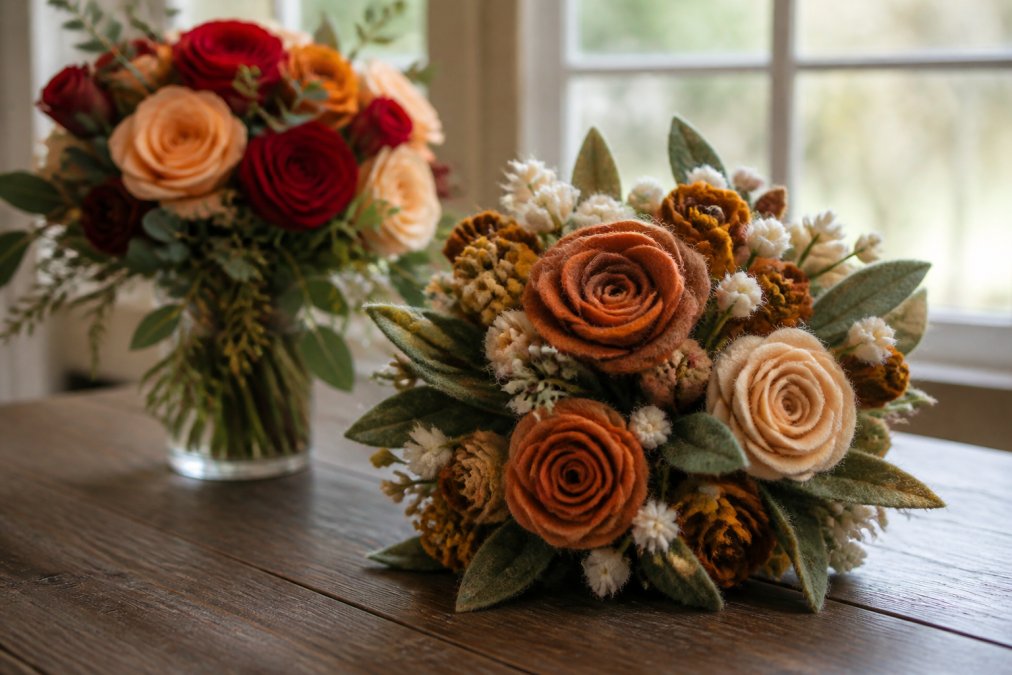
Handcrafted felt wedding florals allow custom colours and styles, creating one-of-a-kind pieces that stay vibrant indefinitely.
An investment in custom felt arrangements (bridal bouquet, bridesmaid bouquets, boutonnieres, centerpieces) becomes lasting home decor.
Hand needle-felted arrangements create realistic texture and colour depth.
Maintenance, Care, and Hidden Costs
Fresh flowers demand daily attention. You refill the vase, trim stems, remove wilted petals, and change the water. This routine takes time, roughly five minutes daily if you're diligent. Over a year, that's 30+ hours of maintenance for flowers that still die.
Hidden Costs That Vary by Season and Climate
Fresh flower costs fluctuate dramatically across seasons. Winter presents the steepest hidden costs. Heated indoor air in homes and offices drops humidity to 20-30%, compared to the 40-60% range fresh flowers prefer. In these conditions, a bouquet that lasts 10 days in spring lasts only 3-5 days in January. This forces more frequent replacements, increasing annual spending by 30-50% during winter months alone.
Climate-Specific Performance for Destination Events
For destination weddings or outdoor events, climate becomes a critical cost factor. A fresh flower arrangement transported to a humid coastal venue may wilt faster due to salt air and temperature fluctuations during travel. Florists often charge premium fees for destination events because fresh flowers require climate-controlled transportation and setup timing that's extremely tight.
Additional Hidden Costs of Fresh Flowers
Beyond seasonal variation, fresh flowers incur costs most people overlook:
- Flower food and preservatives: Specialty packets cost $1-3 per bouquet. Over a year of weekly purchases, that's $50-150 in additives.
- Vase replacement and specialty containers: Different arrangements require different vases. A collection of vases costs $100-300 over time.
- Water treatment: In areas with hard water, mineral buildup requires vase cleaning supplies and time.
- Disposal and composting: Green bin fees in some municipalities apply to floral waste. Over a year, this adds $20-50 to the true cost.
- Replacement purchases due to premature wilting: Unexpected wilting forces emergency purchases at premium prices (grocery store flowers cost 20-30% more than florist bouquets).
Which Option Wins for Your Budget and Lifestyle
Fresh flowers make sense only if you genuinely enjoy the weekly purchase ritual and accept the cost as part of your lifestyle. They're best for people who view flowers as temporary decoration, a mood boost rather than an investment.
Decision Framework: Fresh vs. Felt by Use Case
Home Decor (Weekly Replacement)
- Fresh flowers: Significant annual cost + 30+ hours maintenance
- Felt flowers: $79-159 one-time investment
- Winner: Felt (break-even in 2-3 weeks)
Wedding Florals (One-Day Event)
- Fresh flowers: Significant cost, discarded after reception
- Felt flowers: $1,500-2,500, becomes permanent home decor
- Winner: Felt (cost-neutral upfront, gains lasting value)
Office or Retail Display (Consistent Appearance)
- Fresh flowers: Significant monthly cost + weekly maintenance labor
- Felt flowers: $200-400 one-time investment
- Winner: Felt (break-even in 2-3 months, eliminates staff time)
Gifts for Allergy Sufferers
- Fresh flowers: Not viable (triggers reactions)
- Felt flowers: Hypoallergenic, lasting keepsake
- Winner: Felt (only practical option)
Seasonal Events (Limited Duration)
- Fresh flowers: Full cost for temporary display
- Felt flowers: Reusable year after year
- Winner: Felt (cost amortizes across multiple seasons)
The DIY Option: Making Felt Flowers Yourself
Needle-felting kits and supplies are available online, and many people enjoy the craft aspect. A DIY approach costs significantly less than purchasing handcrafted arrangements.
However, there's a trade-off. DIY felt flowers require:
- Time investment: 2-4 hours per arrangement for someone learning the craft
- Skill development: The first 5-10 arrangements look noticeably less polished than professional pieces
- Supply costs: Merino wool, felting needles, and tools cost $50-100 upfront, then $5-15 per arrangement
- Consistency challenges: Achieving uniform colour and realistic petal shapes requires practice
Final Recommendation by Priority
Choose fresh flowers if:
- You enjoy the ritual of weekly flower shopping
- You want natural fragrance (felt has no scent)
- You view flowers as temporary mood boosters, not investments
- Your budget is under $300/year and you accept replacement costs
Choose felt flowers if:
- You want lasting beauty and consistent quality
- You have allergies or live with someone who does
- You're planning a wedding and want keepsakes
- You want to eliminate recurring expenses
- You live in a climate with extreme seasonal variations (very dry winters, very hot summers)
- You're gift-giving and want the recipient to treasure the piece long-term
Choose DIY felt if:
- You have 30+ hours available and enjoy crafting
- You want to minimize costs for large events (15+ arrangements)
- You want to customize colours and styles
- You view the creation process as part of the value
For weddings specifically, handcrafted felt flowers are transformative. You get custom, artisan-made arrangements that become part of your home. The aesthetic is modern and artistic. The durability means these pieces are long-lasting.
Frequently Asked Questions
Are felt flowers cheaper than fresh flowers in the long run?
Yes. A single fresh bouquet costs $30-$75 and lasts 7-14 days, meaning you spend $1,560-$3,900 annually if you replace it weekly. A handcrafted felt arrangement costs $59-$159 upfront and lasts years without replacement, wilting, or maintenance. Over 12 months, felt flowers cost a fraction of what you'd spend on fresh blooms, especially if you prefer multiple arrangements throughout your home.
What is the total annual cost of maintaining fresh flower arrangements?
Fresh flowers require weekly or biweekly replacement at $30-$75 per bouquet, plus water, flower food, and vase cleaning supplies. That totals roughly $1,560-$3,900 per year for one arrangement. If you keep multiple bouquets in different rooms, costs double or triple. Felt arrangements eliminate these recurring expenses entirely, no water, no food, no replacement cycles.
Do felt flower bouquets hold their value as keepsakes?
Felt flowers retain their appearance and structural integrity for years, making them genuine keepsakes. Unlike fresh blooms, which wilt and disintegrate within days, handcrafted felt arrangements from Merino wool stay vibrant and realistic indefinitely. Many customers display them as permanent decor or pass them on as lasting gifts, creating emotional and practical value that fresh flowers cannot match.
How does the price of custom Merino wool felt flowers compare to premium fresh stems?
Premium fresh arrangements from high-end florists cost $100-$200 per bouquet and last 1-2 weeks. Handcrafted felt bouquets range from $59-$159 and last for years. When you factor in the number of times you'd need to replace fresh flowers to match the lifespan of felt, a single felt arrangement becomes significantly more cost-effective. You're paying once for lasting beauty rather than repeatedly for temporary blooms.
Ready to invest in lasting floral beauty? Explore Felted Flowers' handcrafted collection and discover custom bouquet options designed specifically for your space. Each arrangement is a unique work of art that brightens your home for years, no watering, no wilting, no weekly trips to the florist. Shop Gallery Art and find the perfect felt arrangement for your home or special occasion.
Leave a comment